
What Does the Future Hold for Liberal Jews in New York?
The city and the Democratic Party may be in the process of changing in some fundamental ways

The past 30 years or so has been a bit of a golden era for memoirs and personal essays, including perhaps my all-time favorite book, Fever Pitch by Nick Hornby. Writing about yourself is seductive (“write what you know,” as the old mantra goes), but I think it is staggeringly difficult to do so without harming the people you love or coming across as solipsistic.
The world probably does not need more personal essays, but I have been trying to write in a slightly more personal register of late. My latest book, The Nonprofit Crisis, contains a handful of first-person stories from my time running the Center for Justice Innovation, and if you search hard enough, you can find a few tales of my personal life in the archives of this Substack. (Here’s one about getting robbed as a teenager.)
This week, I have written about how it feels to be a liberal Jewish New Yorker in the wake of the recent New York City Democratic congressional primaries, where three left-wing candidates triumphed by making opposition to Israel central to their campaigns.
When surprising elections happen, there is often a temptation to over-interpret the results. Progressive wins in low-turnout, off-year New York City primaries are not necessarily harbingers of lasting political change across the nation. Still, it does feel like something may be shifting, which prompted me to write the piece pasted below for the Forward.
I moved to New York City in the early 1990s. My original commitment was for only one year, but I quickly fell in love with the place. Part of the appeal was the city’s Jewishness.
Everywhere you looked, there were signs of Jewish influence. This was an era where people repeated jokes from Seinfeld by the water cooler. And it was conventional wisdom that any candidate who wanted to hold office in New York had to appeal to the three “I’s” — Italy, Ireland, and Israel.
While being Jewish was not a big part of my identity — I am not religious and have always lived an assimilated life — I immediately felt comfortable in this kind of environment. I intuitively understood the humor and the rhythm of the city. Many prominent New York public officials — figures like Ed Koch and Ruth Messinger — were familiar types that I recognized from my extended family gatherings.
And so I ended up staying put, becoming yet another liberal Jewish New Yorker. For more than 30 years, I never really thought much about these three overlapping identities — liberal, Jew, New Yorker — because I didn’t have to. Nothing could be more natural than being a liberal Jewish New Yorker — the town was practically teeming with people more or less just like me.
The number of Jews in New York has remained basically the same since I first moved here, but the city no longer feels quite as hospitable as it once did. In fact, some prominent commentators and publications have begun asking: Is it still safe for Jews in New York?
This question doesn’t come out of nowhere. The years since Oct. 7, 2023 have been challenging for Jews in New York. The day after the attack, the New York City chapter of the Democratic Socialists of America held a gathering in Times Square to show their support for the Palestinian cause, marching under the banner “by any means necessary.” This was the start of a season of protest that featured encampments and demonstrations at many New York universities.
The energies unleashed by the pro-Palestine protest movement could not be contained on campus. Events kept landing closer and closer to my doorstep. The Israeli restaurant around the corner from my house was vandalized. My friend Andy Bachman, a liberal rabbi, was prevented from speaking at a Brooklyn bookstore because he supports the existence of Israel.
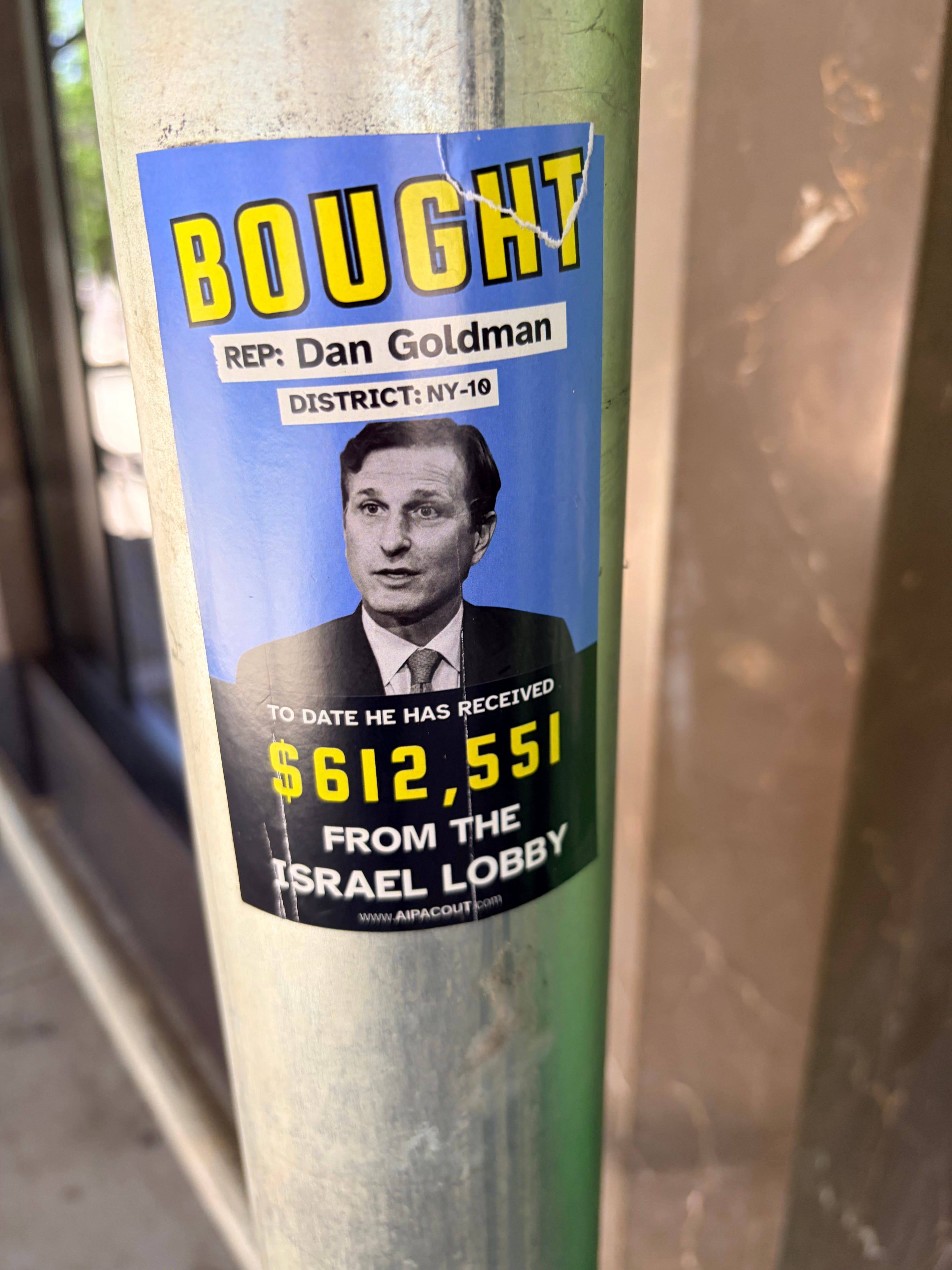
Then, last week, my congressman, Rep. Dan Goldman, went out to get a cup of coffee at Poetica, a café in Brooklyn. Afterward, Poetica posted a photo of him on Instagram, along with a message that the coffee shop does not serve “genocide enablers.” The post added, “Too bad we didn’t recognize you right away, or we would have turned you away.”
This insult was soon followed by (political) injury: Goldman lost his primary to Brad Lander, whose campaign was largely focused on accusing Goldman of not being tough enough on Israel, even though Goldman has been critical of the conduct of the war in Gaza and supportive of imposing conditions on American aid.
All of this is disconcerting, but let’s be clear: Today’s New York City is not Weimar Germany. Rep. Ritchie Torres — among the Democratic Party’s most vocal and consistent defenders of Israel — just won his primary by a wide margin. New York City Mayor Zohran Mamdani has repeatedly vowed to protect the local Jewish community. Indeed, Mamdani likely would not have been elected without the support of roughly a third of Jewish voters.
New York City may still be safe for Jews, but what is less clear is whether the default position of many liberal Jews — who are critical of the Netanyahu government and supportive of a two-state solution — still has a place in the Democratic Party, either locally or nationally.
In Exit, Voice and Loyalty, economist Albert O. Hirschmann argued that when people are confronted by a deteriorating situation, they effectively have three options: to accept the decline, to leave, or to stay and fight. Jews have been building institutions and fighting for belonging in New York City for hundreds of years. Abandoning that work now would be a colossal overreaction.
However, liberal Jewish New Yorkers who choose to stay in the city will have to reckon with a changing reality. The demographics of New York have shifted. The Muslim population has grown. Younger New Yorkers have different political instincts than the generations that preceded them.
The recent New York congressional primary victories by three candidates who are extremely critical of Israel are not flukes — they are reflective of a significant turn in public opinion.
There has been a massive erosion of public support for Israel in the United States in recent years, with Americans now expressing more sympathy for the Palestinians than Israelis. Writing in Jewish Currents, Peter Beinart triumphantly announced: “Restricting U.S. support for Israel is no longer politically perilous; it’s politically expedient.”
The question is no longer whether the Democratic Party should include activists who are fiercely opposed to Israel. That ship has sailed. The question is whether the party — and polite society — will follow Poetica’s lead and declare people like Dan Goldman unwelcome.
Is there still a place in the Democratic Party for liberal Jews who believe in Israel’s right to exist? It remains to be seen. But for the first time in more than 30 years, I find myself thinking about the words “liberal,” “Jewish” and “New Yorker” as potentially separable things. I doubt I am the only one.