
The Woke Explainer
My affection for a niche literary genre

One of my favorite literary genres at the moment is what might be called the woke explainer. This is admittedly a niche genre. And my interests are actually a niche within a niche — I’m not interested in anti-woke screeds and I’m not interested in spirited defenses of wokeness. What I want to read are fair-minded, critical appraisals of the social justice trends that have transformed so many institutions over the past decade.
I’ve already used this space to highlight a few exemplars of the genre, including Yascha Mounk’s The Identity Trap and Freddie de Boer’s How Elites Ate the Social Justice Movement. Mounk’s approach is that of an intellectual historian, tracing the origins of wokeness in academic theories (intersectionality, critical race theory, etc). (Adam Kirsch does something similar with On Settler Colonialism, which is a helpful tool for anyone trying to understand the political reaction to the war in Gaza.) By contrast, de Boer is less interested in the roots of today’s social justice activists and more concerned with their present-day political impacts. The dominant theme of his book is disappointment — he bemoans the failures of left-wing activists to turn the unprecedented public support for change that existed in the years following the killing of George Floyd into material improvements in the lives of disadvantaged Americans.
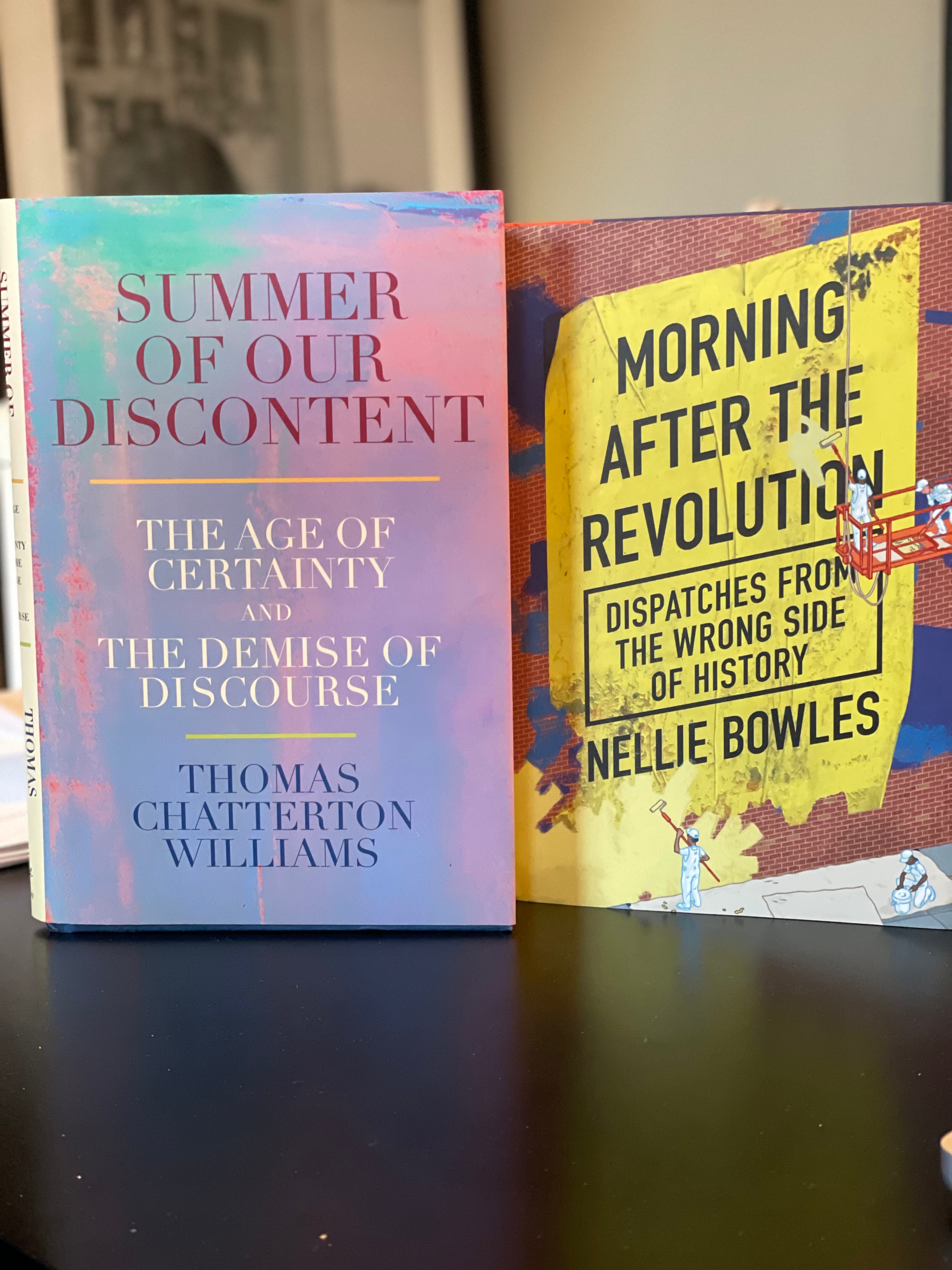
I recently finished two other notable examples of the woke explainer: Thomas Chatterton Williams’ The Summer of Our Discontent and Nellie Bowles’ Morning After the Revolution. Both are worthy additions to the growing canon, helping readers to make sense of an undeniably crazy period in American history.
Bowles and Williams both give the devil its due: they begin by admitting to the many things that the social justice movements of the past decade has gotten right. I’m not sure how Bowles and Williams would characterize themselves politically, but I’m guessing that both would identify as left-of-center, with a healthy concern for racial justice, gender equality, and the strength of our social safety net. While Bowles and Williams are sympathetic to many of the professed goals of Black Lives Matter, #Me Too, trans activists, etc., they are lacerating in their appraisals of contemporary left-wing identity politics.
Bowles primarily mines the years since 2020 for humor, chronicling the absurdities of diversity trainings, cancellation campaigns, land acknowledgements and more. Although Morning After the Revolution does have its funny bits, its strongest moments are actually its most heartfelt. Bowles is at her best recounting the failures of progressive policymaking in her hometown of San Francisco. As she documents, local residents eventually rebel, voting to expel a number of prominent left-wing officials, including the district attorney and several school board members. Bowles’ conclusion is that “dogmatism buckles under pressure from reality.” She writes:
There is a sense that, on everything from housing to schools, San Francisco had lost the plot — that progressive leaders here have been LARP-ing left-wing values instead of working to create an actual livable city. And many San Franciscans had had enough…The fight was leftists versus liberals. It was between idealists who think a perfect world is within reach — it’ll only take a little more time, a little more commitment, a little more funding — and those who are fed up.
Bowles’ take on San Francisco has proven prescient. Since she wrote Morning After the Revolution, the backlash to progressive overreach has continued, culminating in the election of Daniel Lurie as mayor — a victory that has been widely interpreted as an endorsement of technocratic moderation at the expense of left-wing ideology.
Have we in fact passed peak woke?
Thomas Chatterton Williams suggests that the answer is yes. Williams spends the bulk of The Summer of Our Discontent documenting the success of social justice advocates in the wake of the killing of George Floyd. He credits activists with shifting the consciousness of millions of Americans and altering the behavior of numerous institutions, including government agencies, universities, nonprofits, and Hollywood studios.
According to Williams, at the root of the social justice worldview is an instinct for “raw dichotomy'':
Actions, policies, and ideas had been decisively reconfigured as either racist or antiracist. The entire country and much of the world beyond it was now filtered through opposing binaries: villain/victim, oppressor/oppressed, colonist/indigenous, white/”person of color.” Whatever grey area might have still been thought to exist between these poles was either a folly or a luxury; whichever it was, we couldn’t afford it.
But Williams believes that this movement has now run aground. He argues that the era of racial reckoning and “moral clarity” has essentially been bookended — with the death of Trayvon Martin marking the start and the October 7, 2023 massacre in Israel marking the culmination. “The conflict in Gaza — and more specifically the contested position of Jews as a category within ‘whiteness’ — fundamentally broke the emergent social justice consensus,” Williams writes.
There is no doubt that October 7th and the subsequent protests on American college campuses have had a major impact, exposing a stark generational divide within the Democratic Party, souring many American Jews on leftist politics, and helping to fuel Donald Trump’s return to power. But I am skeptical that October 7th marks the end of the “Great Awokening.” I think many of the ideas at the heart of the social justice worldview — an obsession with group identity, the belief that the “personal is political,” an inconsistent commitment to free speech, etc. — continue to exert a powerful hold in American life. It is too soon to draw any definitive conclusions from the election of Zohran Mamdani, but it is certainly true that his progressive orientation did not prove to be disqualifying with the New York City electorate. We may well be seeing more Mamdanis in our future.
I liked both Williams and Bowles’ books, but I think they work best in conversation with other woke explainers rather than as standalone products. If journalism is the “first draft of history,” these books feel like the second draft — more nuanced, but not yet definitive. I think there is still room for deeper, more penetrating analysis.
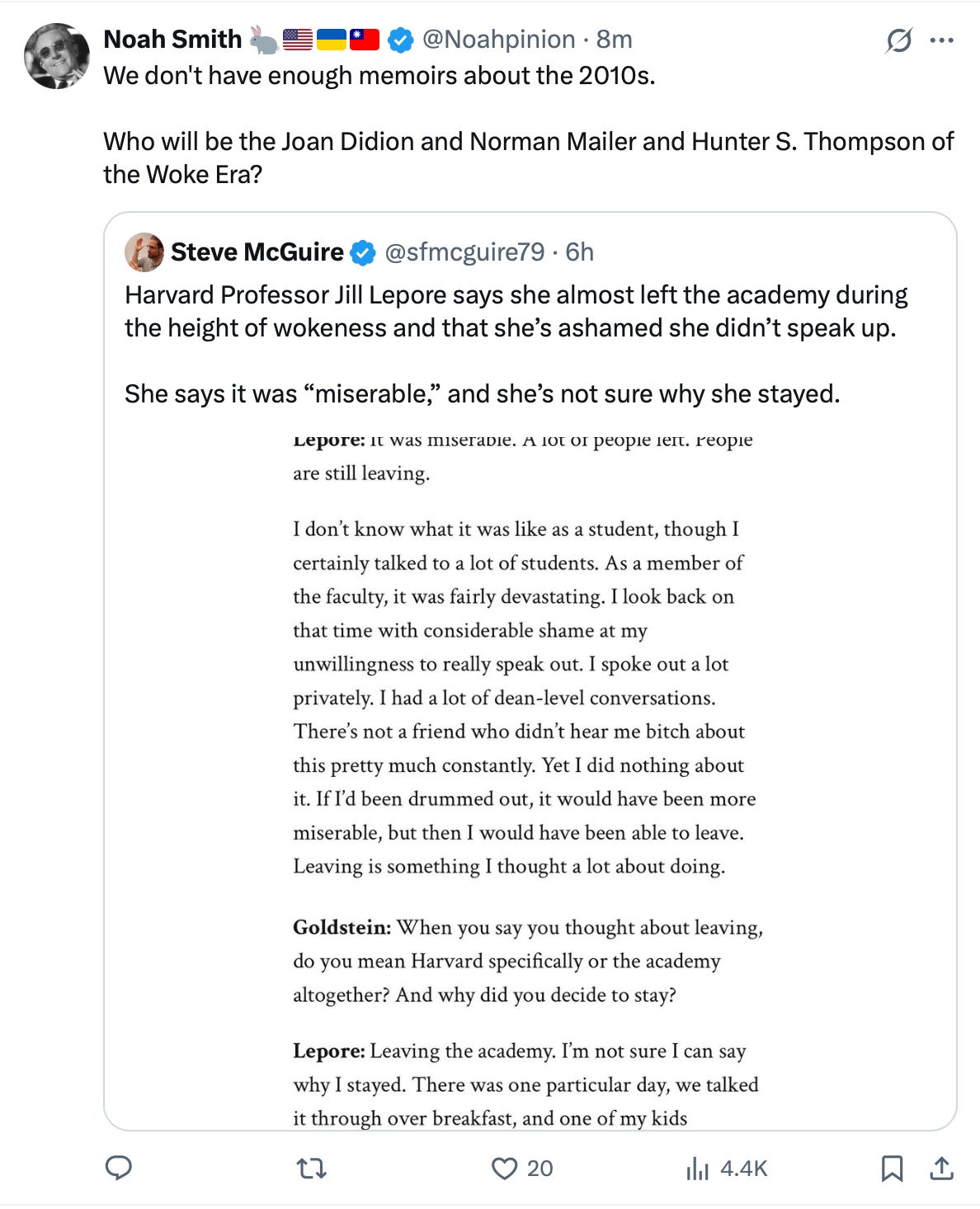
I agree with Noah Smith’s take: the Joan Didion or Tom Wolfe of our times has not yet emerged. (Although I must admit that I recently re-read “Radical Chic” and found it a little disappointing. ) I sincerely hope that there is an army of critics and commentators feverishly working on the next generation of woke explainers. I, for one, am here for them.
PS — The Stanford Social Innovation Review has published an excerpt from my new book, The Nonprofit Crisis. The piece is called “The Seduction of Nonprofit Mission Creep,” and it looks at how my thinking about mission statements has evolved over the years — when I ran the Center for Justice Innovation, I strenuously resisted writing a mission statement, but now I see them as an important defense mechanism against mission creep.